Park City Closed $668 Million in One Quarter. Custom Home Buyers Are Misreading It.
Park City recorded $668 million in real estate sales across 196 transactions in the first quarter of 2026. Eight of those closed above $10 million — during ski season, with interest rates still elevated, and with tariff uncertainty baked into every contractor's bid.
The usual response to a number like that: the market is hot, now is the time to build, get moving. That read is not wrong. It is also incomplete in ways that matter if you are about to spend four or five years of your life on a custom home.
What's Actually Being Built
Deer Valley just redrew its map. The East Village — formerly Mayflower Mountain Resort — launched the largest ski terrain expansion in North American history, growing to 5,700 skiable acres across 10 peaks and becoming one of the four largest ski resorts in the nation. The Grand Hyatt opened in late 2024. The Four Seasons Resort and Private Residences is under construction, with more than 40% of units already sold at prices reaching $11 million for a townhome. The Canopy by Hilton is set to open summer 2026. The East Village Lodge is on track for substantial completion by September 2026, in time for the 2026/27 season.
At the same time, the Sun Peak Homeowners Association filed suit in May 2026 challenging Summit County's approval of an amended Utah Olympic Park development agreement — arguing that expanded development rights were granted without adequate review of traffic, wildlife, and fiscal impacts. The County Council approved the deal unanimously in April, opening the door for new construction, nightly rentals, and long-term housing adjacent to the Olympic venues.
Two stories. One market. For someone building a custom home in this region, they point in opposite directions.
What the Headline Number Conceals
The $668 million is real. What it conceals is the compression happening underneath it.
The transactions driving that figure are concentrated. Eight closings above $10 million in a single quarter represents a very specific segment — ski-in/ski-out estates, legacy properties, and pre-construction luxury residences tied to the Deer Valley and East Village expansions. The median single-family home in Park City now trends above $2.5 million. But the median is being pushed by a stratum of sales that bear limited resemblance to what a custom home client is actually navigating.
What the headline number does not tell you: lot availability near Deer Valley is tightening faster than most people realize. The Four Seasons and Marcella Landing absorbed significant inventory at the high end — 19 of Marcella Landing's 50 townhomes are already sold at prices reaching $11 million or more. Communities like Promontory, Tuhaye, and Benloch Ranch — where a custom home buyer actually has land to build on — are operating under different supply conditions.
And the cost environment has changed materially. Section 232 tariffs effective October 2025 imposed a 10% duty on softwood lumber. Steel carries a 50% tariff. Imported cabinets remain at 25% through at least January 2027. Framing lumber sits around $872 per thousand board feet — up nearly 13% year-over-year. The NAHB estimates an average of $17,500 added per new home from tariffs alone. In Park City, where custom builds at this level routinely involve specialty cabinetry, imported stone, European fixtures, and structural steel, the real number is higher.
The $668 million tells you the market wants what Park City is selling. It does not tell you what that costs to build today, or how long it takes to get there.
What's Actually Happening in the Communities That Matter
Deer Valley East Village, upon completion, will feature 800 luxury hotel rooms and more than 1,800 private residences — a range spanning estate lots to luxury condominiums. When a development at that scale lands in a market this size, it does not simply add inventory. It resets the benchmark.
Buyers touring a Four Seasons residence at $11 million are establishing their reference point for what mountain luxury looks like. When those same buyers then explore a custom home at Promontory or Tuhaye — where they can build something more personal, more specific, more permanent — they arrive with elevated expectations and a price context anchored at the high end of the market. For the right builder, that dynamic is an opportunity.
The distinction matters because custom home buyers at the $3 million to $10 million range are not buying a hotel room with a deed. They are commissioning a structure designed for their life, built over 18 to 24 months, on land that may require significant site work before the first framing wall goes up. In Park City communities, that can mean 20-degree slopes, bedrock, soil conditions requiring pier foundations, and design review board processes that add meaningful time to a permitting timeline before a shovel moves.
The Wasatch Back Land Equation
Benloch Ranch in Heber City is one of the few remaining communities in the Wasatch Back where a custom home buyer can secure a lot and build with some margin for the process. Promontory sits at a similar stage of development — enough community infrastructure to feel finished, enough remaining lots to feel possible. Tuhaye, on the east side of Jordanelle Reservoir, is watching the Deer Valley East Village closely.
What these communities share: they are not Deer Valley. Which is exactly why a certain buyer chooses them. The custom home buyer who drives through the Four Seasons sales center and then calls a builder is often someone who has decided they want ownership, not amenity. They want the specific home they have imagined, in a community with a viewshed they chose, built to a timeline that reflects their life — not a hotel's opening schedule.
The Timeline Reality
A custom home in Park City started today — assuming land is secured, architect engaged, and design development completed efficiently — is realistically a 2027 or 2028 move-in. Eighteen months is the floor for a straightforward build. Complex sites, which describes most of the remaining premium lots in the Wasatch Back, add time. Design review boards add time. A mountain modern home at 7,000 feet is not a Phoenix tract home on a flat pad; the construction calendar runs on its own logic.
The buyers who are building the homes they will actually want in 2028 started those conversations in 2025 or 2026. The ones reading the Q1 market numbers today and deciding to wait for "the right moment" are, in most cases, deferring the conversation by a year or more.
"The clients who ask us when to start are usually asking the wrong question. The right question is what you want to be living in when the 2034 Olympics comes to your backyard. If the answer is something you built yourself, on land you chose, the timeline runs from now." — Trapper Roderick, President, Roderick Builders
What Other Builders in This Market Aren't Saying
Most builder content in this market offers celebration: award announcements, project reveals, lifestyle photography. What it rarely offers is interpretation. A builder with enough projects completed to read the signals — in permit data, in land absorption rates, in what sub-contractors are quoting and how far out they are booking — has access to market intelligence that no real estate data aggregator publishes.
That is a different kind of value from a floor plan.
Reading the Pattern
The pattern of high-profile resort development preceding a surge in custom home demand is not unique to Park City. Jackson Hole saw it. Aspen saw it. What distinguishes the Wasatch Back is the combination of scale — the Olympic infrastructure, the Deer Valley expansion, the Andaz Heber Valley — and the remaining availability of buildable land.
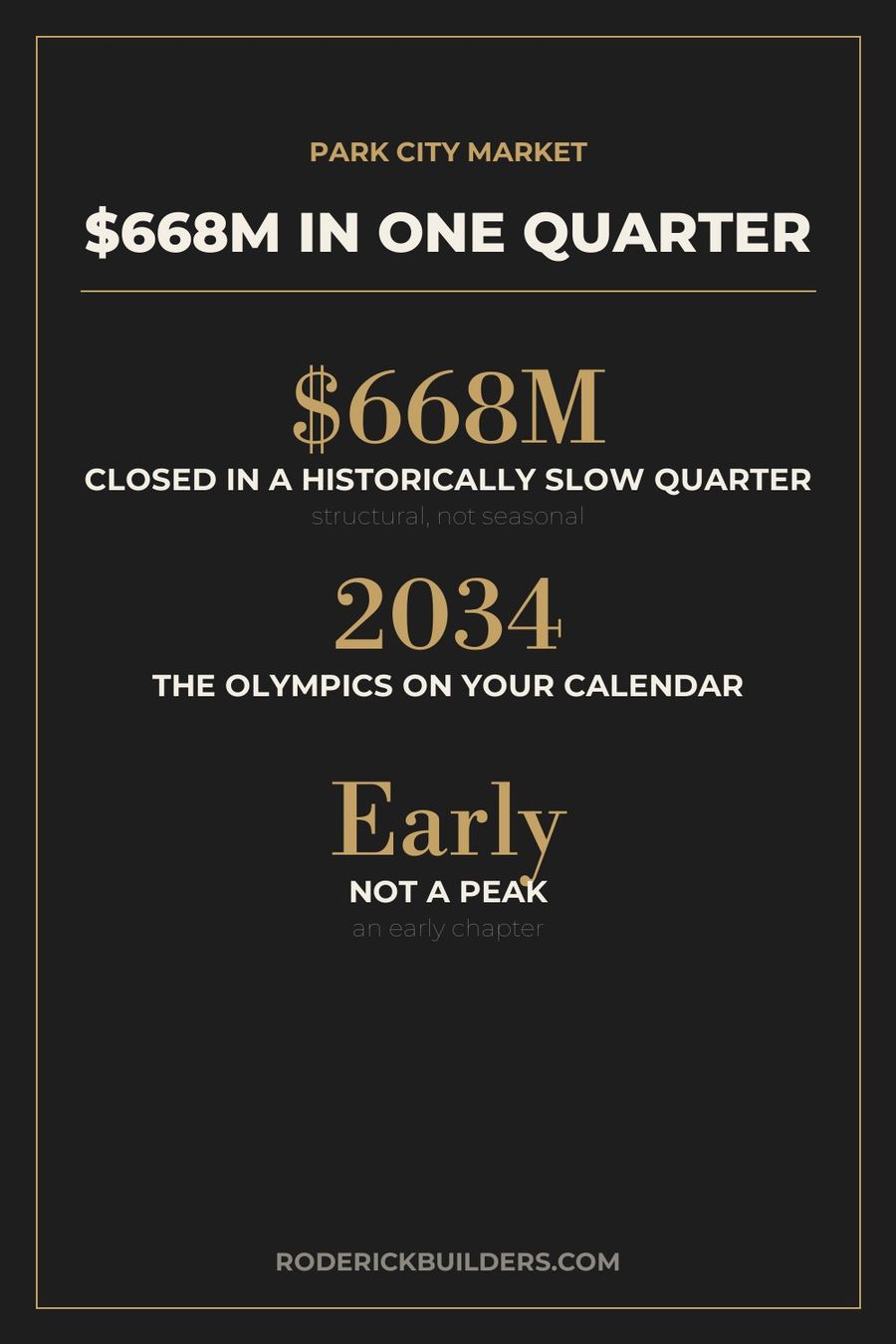
"When a market this size absorbs $668 million in a quarter that is historically slow, that signals something structural, not seasonal. What’s happening near Deer Valley is not a peak — it’s an early chapter." — Trapper Roderick, President, Roderick Builders
The Conversation Worth Having
The $668 million is a real number. What it reflects is real demand from serious buyers. What it does not reflect is the full picture of what building in this market looks like from the inside — the timelines, the costs, the site realities, the permitting sequences that determine when a vision becomes a structure.
If you are thinking about building a custom home near Deer Valley, at Promontory, at Tuhaye, at Benloch Ranch, or anywhere in the Wasatch Back, the conversation worth having is not about market timing. It is about what you want to build, and what it actually takes to get there.
Let's start a conversation.
Frequently Asked Questions
Does the Deer Valley East Village expansion affect custom home prices in nearby communities?
Yes, and in more than one direction. The expansion raises the benchmark for what luxury mountain living looks like — which generally supports pricing at Promontory, Tuhaye, Benloch Ranch, and communities along the Jordanelle corridor. At the same time, it draws buyers and capital to a specific geographic area, which can accelerate land absorption and tighten the pool of available custom home lots. For a custom home buyer, the practical effect is pressure to move earlier in the process, not later.
What is the actual timeline for a custom home build near Park City in 2026?
From first site selection to move-in, most custom homes in this market take 18 to 30 months depending on site complexity, design scope, and permitting. Design development and land entitlement typically run 6 to 9 months before construction begins. Communities with active design review boards add additional time to permitting. Complex sites with significant slope or unusual soil conditions add more. A realistic expectation for a project started today is a 2027 or 2028 completion.
How are 2026 tariffs affecting the cost to build a custom home in Park City?
Material costs have risen materially. Framing lumber is up approximately 13% year-over-year, sitting around $872 per thousand board feet. Steel carries a 50% tariff under Section 232; aluminum mill shapes rose 33% year-over-year through January 2026. Cabinet tariffs of 25% remain in effect through at least January 2027. The NAHB estimates an average of $17,500 added per new home nationally, but custom luxury builds in Park City — with higher reliance on specialty wood products, structural steel, and imported stone and fixtures — typically absorb more.
What is the cost per square foot to build a custom home in Park City in 2026?
The range for a custom luxury home in Park City is $500 to over $1,000 per square foot, depending on site conditions, design complexity, and finish level. Mountain modern homes with extensive glass walls, structural steel, and high-performance building envelopes tend to sit in the upper half of that range. Site costs — grading, utilities, retaining structures — frequently run $300,000 to $600,000 or more before framing begins on steep Wasatch Back lots.
Is the Promontory Club still a good community to build a custom home in 2026?
Promontory remains one of the most established private communities in the Wasatch Back, with golf, equestrian, ski access, and a mature amenity set that took years to build out. It sits in a different position than the emerging Deer Valley East Village communities — less raw, more proven, with a buyer profile that values permanence over novelty. Available lots are fewer than they were five years ago, which has implications for both land pricing and build timeline expectations.
Is Benloch Ranch still a good place to build in 2026?
Benloch Ranch in Heber City continues to be one of the most compelling custom home opportunities in the Wasatch Back. With direct views of Mount Timpanogos and the Deer Creek drainage, it offers the elevation and setting of a Park City community at a land cost that remains accessible for a serious custom home buyer. It lacks the brand cachet of Promontory or Tuhaye, which is precisely why it attracts a particular type of client — someone who values what the land itself offers over what the gate sign says.
What should I ask a custom home builder before starting a project in Park City?
The most useful questions are operational, not aesthetic. Ask how many projects the builder has completed in the specific community you're considering — each design review board has its own history and that matters. Ask how far out their sub-contractor network is booked, particularly for structural steel, framing, and mechanical. Ask how they are managing material procurement under current tariff conditions — whether they are pre-purchasing, using domestic alternatives, or absorbing spot-market volatility. And ask for a realistic timeline, stated as a range with explicit assumptions, not a best-case number.