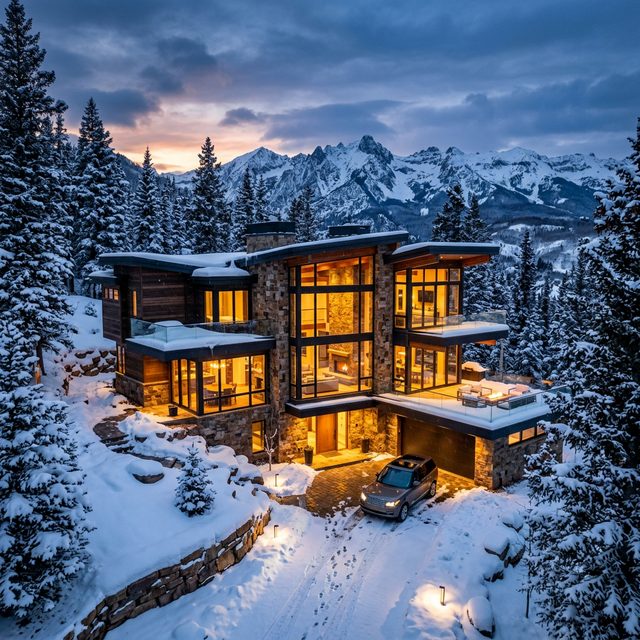
Ski Resort Homes
Ski Resort Homes &
Ski-In/Ski-Out Estates.
Custom ski-in/ski-out homes and on-mountain estates across Deer Valley, The Colony at White Pine Canyon, Marcella Club, SkyRidge, and Promontory. Slope-side engineering by a fifth-generation design-build firm.
Slope-Side Building
The Hardest Home in the Market.
We Build Them on Purpose.
A ski-in/ski-out home is not a luxury home with a better view. It is a structural and logistical problem disguised as a dream. The lot is steep. The snow load is brutal. The access window is short. The Design Review Board is strict. And the budget can run away from you before the foundation is even poured.
That is exactly the build Roderick Builders was made for. We are not a general contractor and we are not a brokerage. We are the Architectural Guardian: the firm that makes sure the emotional intention behind a slope-side design actually shows up in the finished home, on a lot where most builders are just trying to survive the engineering.
Access Tiers
What "Ski-In/Ski-Out"
Actually Means.
This is the question every buyer asks and almost no listing answers honestly. Before you fall in love with a lot, know which tier you are actually buying.
Clip in at your own door, ski to a lift, ski back to your door. No shuttle, no walk. The real thing — and the most expensive on-mountain product there is.
You can ski directly to or from the structure, but the "in" and the "out" may not be symmetrical. Common in well-planned slope-side developments.
The resort terrain meets the project boundary — but not your specific door. Frequently marketed as ski-in/ski-out. It is not the same thing.
A recorded ski easement gives your lot legal, deeded access to the mountain. The experience depends on grade, distance, and maintenance.
A private ski club or dedicated shuttle delivers you to the lifts. Excellent convenience — but access, not ski-in/ski-out. Communities like Promontory and Glenwild deliver world-class living on this model.
Investment
What It Costs to Build.
And Why Slope-Side Sits at the Top.
Custom mountain homes in Park City run $500–$1,000+ per square foot. Standard ($500–$650), Premium ($650–$850), and Ultra ($850+). Ski-in/ski-out builds routinely land at the very top of that range.
You are not paying a premium for the address. You are paying for difficulty: steep-lot excavation and rock removal, soil-nail and retaining-wall systems, cold-weather concrete, snowmelt systems, structural overengineering for resort-grade snow loads, HVAC sized for 7,000–9,000 feet, and crane and material logistics on a slope where there is no flat staging area.
We do not hide that math. We put it in front of you in plain language before design begins — which is the entire point of The Alignment.
Building Science
The Mountain Engineering Reality
At Resort Elevation.
Snow Load & Roof Geometry
Ground snow loads run well past 100 PSF. A steep pitch sheds snow but adds wind exposure. A flat mountain-modern roof holds snow, requiring structural overengineering, active snowmelt, or both.
Steep-Terrain Foundations
Slope-side lots demand soil-nail walls, engineered retaining systems, and foundations designed to hold grade through freeze-thaw cycles year after year.
Cold-Weather Concrete & Freeze-Thaw
Pouring at altitude in a short season requires cold-weather protocols — heating, blankets, accelerators. Detailing must defeat ice dams and survive thousands of freeze-thaw cycles.
High-Performance Envelope
We specify Rockwool mineral wool — batt insulation and continuous rigid board — because at this elevation you need thermal performance, moisture tolerance, fire resistance, and acoustic control all at once.
We also specify Pentair / Naie Everpure water filtration so the water at the tap matches the quality of everything else in the house. Read more on cold roofs and Summit County building codes.
Where We Build
On-Mountain Communities
We Know by Name.
Every resort community governs its own architecture through a Design Review Board. The rules differ, the timelines differ, and approval is a build phase — not a formality. We know these boards.
Deer Valley
The highest concentration of true ski-in/ski-out terrain in the region. The tightest, highest-value terrain in the market.
Marcella Club
A newer Deer Valley-area private club community with on-mountain homesites and its own design review standards.
The Colony at White Pine Canyon
Some of the largest ski-in/ski-out homesites in the Park City area — big lots, big elevation, big snow.
SkyRidge
A newer master-planned community on the Deer Valley side, with ski-out access and its own architectural review.
The Spec
What a Real On-Mountain
Estate Is Built Around.
A great ski house is organized around the way you actually arrive home cold, wet, and carrying gear. The architecture serves the ritual.
Active gear-drying systems — boots, gloves, and helmets warm and dry by morning.
The ski room is a workshop, not a closet.
A clean path from the snow to the heart of the home — without tracking the lodge through the great room.
Never shoveling, never stuck.
The right heating strategy for a high-altitude stone-and-timber house.
Outdoor hot tub, multiple fireplaces, covered decks engineered for snow load. The whole reason to own a ski home.
Budget Protection
The Alignment:
How We Protect Your Budget on the Most Volatile Lot in the Market.
Here is the number-one fear of every slope-side build: the budget blows up because of something nobody could see — rock, water, access, a retaining wall that doubled. On a ski lot, those unknowns are not edge cases. They are the terrain.
Our answer is The Alignment — our pre-construction process. Before any design begins, we get the architect, the engineer, the interior designer, and you oriented to the same budget and the same vision. Then we hold the line with work-in-progress (WIP) accounting: every invoice shows original budget, current budget, approved change orders, paid to date, and projected balance.
Read the full process on our process page.
Timeline
18–24 Months
First Conversation to Keys.
The variables: DRB design review, Summit County permitting, and the compressed mountain building season. See our timeline guide.
Market Outlook
The 2034 Olympics
Thesis.
Utah is in a structural bull case: sustained population growth, Silicon Slopes, and the 2034 Winter Olympics. The $7M+ tier moves faster than the mid-market, and true ski-in/ski-out terrain is finite.
Heritage
Built by the
Fifth Generation.
Roderick Builders is led by Trapper Roderick — president and a fifth-generation builder (Utah DOPL License #11753372-5501). Our father, Travis Roderick, leads California operations and has built nearly $1B across fewer than 40 homes. The maternal line runs to Jacobsen Construction, founded in the 1920s.
"Is it the fit and finish? Or is it that there was emotion that was controlled in the space — by using certain materials in certain ways and the way it was finished?" — Trapper Roderick, BST Podcast
Built to Push the Standard.
Common Questions
Frequently Asked
Questions.
What does ski-in/ski-out actually mean, and how is it different from ski access?
True ski-in/ski-out means you clip in at your own door, ski to a lift, and ski back to your door — no shuttle or walk. "Ski access," "ski-to-door," and "ski-into-project" are weaker tiers. They are valuable, but they are not the same as front-door access, and the price should reflect the difference.
Which Park City and Deer Valley communities offer true ski-in/ski-out homesites?
The most concentrated true ski-in/ski-out terrain is in the Deer Valley area, plus The Colony at White Pine Canyon, Marcella Club, and SkyRidge. Each community governs construction through its own Design Review Board. Roderick builds across these communities and maps the access tier of each lot during pre-construction.
How much does it cost to build a ski-in/ski-out custom home in Park City?
Ski-in/ski-out custom builds sit at the top of the $500–$1,000+ per square foot mountain-home range. The premium reflects steep-lot excavation, soil-nail and retaining systems, snowmelt, cold-weather concrete, structural overengineering for snow load, altitude-sized HVAC, and slope-side crane logistics.
What snow load must a roof be engineered for at Deer Valley elevations?
Ground snow loads at resort elevation run well past 100 PSF, and design loads are lot- and code-specific. The roof tradeoff: a steep pitch sheds snow but adds wind demands, while a flat mountain-modern roof holds snow and requires overengineering, active snowmelt, or both.
What are the main construction challenges of building on a steep ski lot?
Steep slope-side lots require soil-nail and retaining-wall systems, foundations engineered for freeze-thaw, cold-weather concrete protocols, ice-dam and high-UV detailing, snowmelt driveways and walks, and a high-performance Rockwool envelope. HVAC must be sized for 7,000–9,000 feet.
What features should a luxury ski home have?
A real ski estate is built around the arrival ritual: a heated ski/boot room with gear-drying systems, a waxing and tuning bench, slope-side mudroom circulation, snowmelt driveways and walks, radiant heated floors throughout, and apres spaces — outdoor hot tub, multiple fireplaces, and covered decks engineered for snow load.
How long does it take to build a ski-in/ski-out home in Park City?
Roughly 18–24 months from first conversation to keys. The variables are DRB approval, Summit County permitting, and the compressed mountain building season.
Can an out-of-state California buyer build a ski home in Park City remotely?
Yes — and it is common. Roderick Builders runs a remote-client process and operates in both Utah and California, with Travis Roderick leading the California side. You get a builder who already manages out-of-state clients at scale.
Is a ski-in/ski-out home in Park City a good investment given the 2034 Olympics?
Utah's outlook is strong: population growth, Silicon Slopes, and the 2034 Winter Olympics returning to Park City venues. The $7M+ tier moves faster than mid-market and is less rate-exposed, and true ski-in/ski-out terrain is finite. Market outlook, not financial advice — but finite premium terrain against rising demand is a durable position.
See all frequently asked questions.
Get Started
Start the
Conversation.
If you are planning a ski-in/ski-out home in Deer Valley, The Colony, Promontory, or anywhere on the Park City mountain — whether you live here or you are building remotely from California — start with The Alignment.
Utah: (435) 222-7198 · California: (310) 658-3288 · Email: contact@roderickbuilders.com
The Guide
Protect the Vision —
Before Construction Begins.
Most homes are compromised before ground is ever broken. This short guide covers the decisions to lock, the questions to ask, and the risks to eliminate while the vision is still on paper.
- Where architect-led designs get diluted — and how to prevent it
- The pre-construction questions most owners never ask
- How to compare builders beyond the bid number
- What "architect & builder aligned" should actually look like
Begin
A Home That Outlasts You.
Not Just Something You Own.
Slope-side building has different rules. Talk to a team that has built on the mountain for generations.
Trapper or Travis will personally respond within 24 hours · or call directly — (435) 222-7198