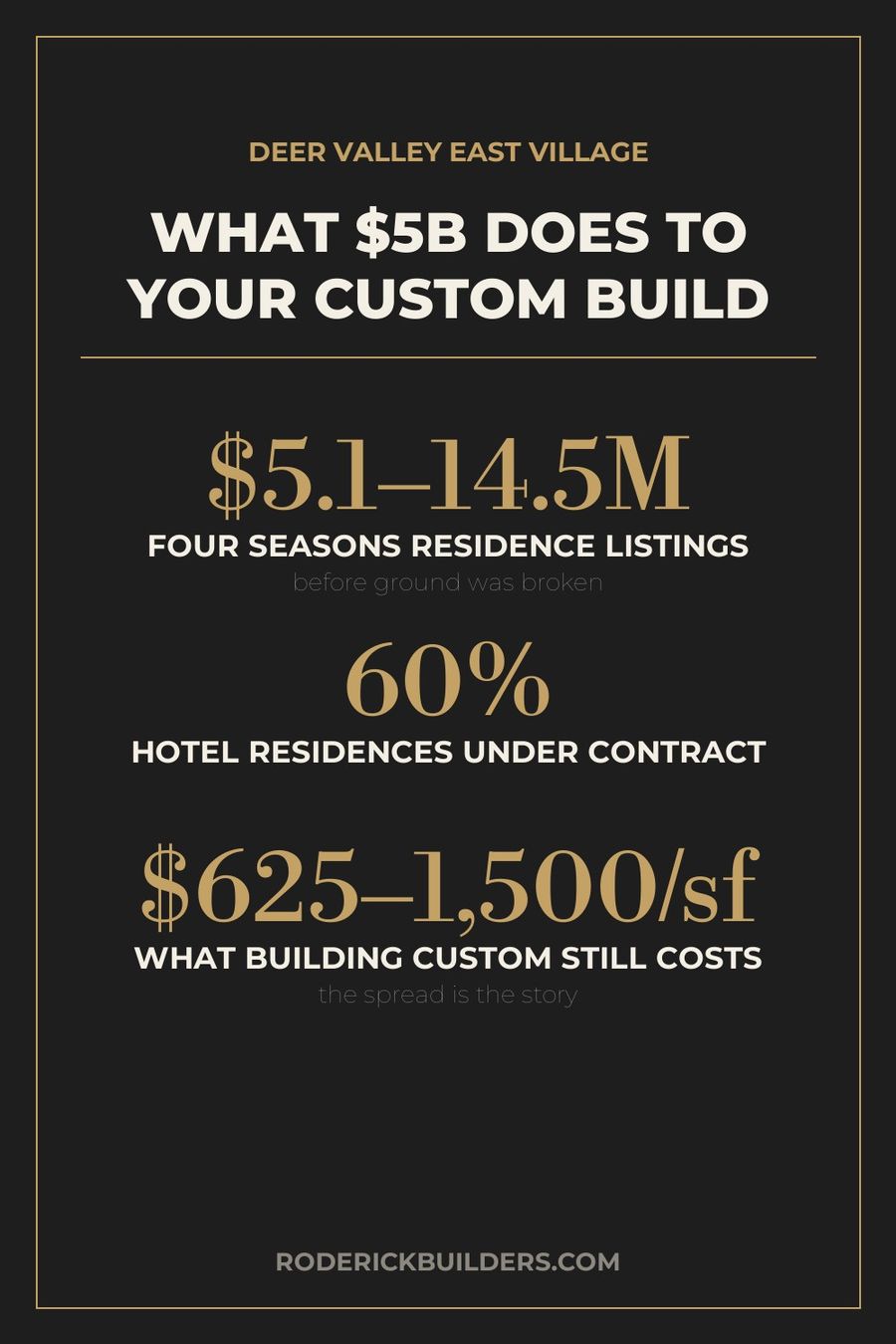
Four Seasons hasn't broken ground yet. Their private residences at Deer Valley East Village already list from $5.1 million to $14.5 million, and roughly 60% of the hotel residences are under contract. That matters to anyone building a custom home in Summit or Wasatch counties. Here is why.
The scale of what just landed
East Village is not a renovation. It is a new neighborhood. Roughly 1,700 residential units, 800 hotel rooms, 100 new ski runs, ten new lifts, and a ten-passenger gondola connecting to Park Peak, tied to a development estimated at $5 billion. The terrain expansion pushed Deer Valley to 5,700 skiable acres, which places it among a small group of elite resorts in North America. The first wave has already cleared the market. The Grand Hyatt opened for the 2025–26 ski season with 55 private residences priced from $2.3 million to $6.9 million, and those sold out. Four Seasons, Cormont, and Waldorf Astoria residences are following on the same corridor. As of March 2026, East Village alone represents about 36% of available new-construction inventory in the Park City and Deer Valley market.
The new public floor for premium mountain real estate
Every market has a price anchor. For two decades, the ceiling for turnkey luxury near the lifts in Park City lived quietly around $4 million to $6 million for a well-appointed ski condo, with estate-level single-family homes trading separately and mostly privately. East Village dragged that number into public view and pushed it up. The new public floor for premium branded residences inside the Deer Valley footprint is closer to $5 million, with the midpoint of the Four Seasons listings sitting near $9.8 million. That is not a condo price. That is a custom-home price.
For a client deciding between buying turnkey at East Village and building custom in Benloch Ranch, Promontory, Old Ranch Road, or Glenwild, the calculation has changed in three concrete ways.
First, the ceiling on what a finished custom home can appraise at has moved up. When a two-bedroom Four Seasons residence lists at $5.1 million and a four-bedroom lists at $14.5 million, the comparables for a 4,500-square-foot custom mountain modern build stop feeling aggressive. They start feeling calibrated.
Second, the ratio between cost-to-build and market value has tightened. Current construction costs in Summit and Wasatch counties run from $625 to $1,500 per square foot for custom work. At $900 per square foot on a 5,000-square-foot home, that is $4.5 million in hard construction, before land and soft costs. Two years ago that number looked steep. Against an East Village comparable, it looks proportional.
Third, the scarcity equation flipped. East Village added roughly 1,700 units in one corridor. The supply of quiet, private custom-home sites in the surrounding communities did not grow at all.
Three shifts in the math
1. The price floor moved, not the build cost
The cost of mountain-grade construction in Park City has climbed for reasons unrelated to East Village. Kitchen cabinets and vanities carry a 50% tariff as of January 1, 2026, up from 25% the previous quarter. Steel and aluminum carry a 50% Section 232 tariff. Canadian softwood lumber, which supplies roughly 80 to 85% of U.S. imports, is now subject to compounded duties that push the effective landed price up by close to 45%. NAHB analysis puts the average tariff impact at $10,900 per home across the national market. In Park City, where metal content, structural steel, specialty glazing, and imported tile are disproportionately represented in the build, the real number sits higher.
What changed at East Village is not cost. It is the ceiling. If your build cost was going to be $4.8 million regardless, the question of whether the finished home supports that number is decided by comparables. Those comparables just got stronger.
2. The quiet inventory is the leverage
East Village is dense by design. The 1,700 units are stacked into a vertical village around a new base area. That is the correct product for ski-in ski-out flexibility and rental optionality. It is also the opposite product from what most of our Benloch Ranch and Promontory clients are looking for.
A 0.4-acre private lot with clean southern exposure and a sight line to Deer Valley or the Jordanelle does not scale. Summit and Wasatch counties are not adding substantial new custom-home subdivisions at the top of the market. Benloch Ranch, Promontory, The Colony, Glenwild, and Old Ranch Road are functionally fixed inventories. When East Village pulls a new international audience toward Summit County, a portion of that demand will look for the quiet side of the street.
3. The 2034 timeline is no longer theoretical
The International Olympic Committee awarded the 2034 Winter Olympic and Paralympic Games to Salt Lake City on July 24, 2024. Freestyle skiing aerials and moguls will be hosted at Deer Valley. Ski jumping, luge, skeleton, snowboarding parallel giant slalom, and bobsled will run at the Utah Olympic Park. The 2002 Games increased property values across Park City for a decade afterward, and projections put the 2034 economic impact at $6 to $7 billion. That is a known, calendared event. If a custom build takes 18 to 30 months from land purchase to move-in, starting design conversations in the first half of 2026 puts a home comfortably finished before the torch arrives.
East Village did not create the 2034 tailwind. It made the tailwind visible. What used to be a speculative conversation about Olympic uplift now has a $5 billion construction project proving out the demand curve.
Turnkey or custom: a cleaner way to frame the decision
Buying at East Village gets a buyer branded service, full rental optionality, ski-in ski-out access on the new terrain, and a resale story that is almost too easy to tell. The tradeoff is density, shared walls, HOA governance of a hotel-adjacent product, and a finished home that looks like every other finished home at the same address.
Building custom in Benloch Ranch, Promontory, or Old Ranch Road gets privacy, a site designed around a specific view corridor, material and floor-plan decisions made for one owner rather than a product line, and a finished home that cannot be replicated without acquiring the adjacent land. The tradeoff is the 18- to 30-month timeline, the full exposure to the current construction cost environment, and the responsibility of design decisions that do not happen to you — they happen with you.
Both are defensible. The mistake is assuming they are priced independently. East Village moved the comparable set for everyone.
What a builder hears in a market like this
"Four Seasons pricing just told every appraiser in the county what this corridor is worth. Build cost didn’t move an inch. That spread is the whole story." — Trapper Roderick, President, Roderick Builders
"I sat with a client in March who was deciding between a Grand Hyatt residence and a lot at Benloch. The old instinct is to say those are different products, different buyers, different conversations. That instinct is wrong right now. East Village just told the entire market what premium mountain real estate is worth, and the number is higher than most of our custom-build clients expected their finished homes to appraise at. That changes how we talk about budget. It changes how we talk about square-footage tradeoffs. It changes how we talk about whether a Wasatch limestone fireplace pencils out. The answer, more often than not, is that it does — and it does with a cleaner margin than it did eighteen months ago."
— Trapper Roderick, Founder, Roderick Builders
The question worth asking
Most buyers are looking at East Village and asking whether to buy in. A smaller number — and historically the more strategic ones — are looking at East Village and asking what the $5 billion next door says about the land they have not bought yet. The ceiling moved. The build cost did not. The private lots did not multiply. If you are within a year of deciding, the math is worth running against current numbers rather than the numbers you had in mind two years ago.
Frequently Asked Questions
Does Deer Valley's East Village expansion make custom home building in Park City more expensive?
East Village did not change the cost to build. Construction costs in Summit and Wasatch counties currently range from $625 to $1,500 per square foot for custom work, driven by material tariffs, labor scarcity, and mountain-grade engineering. What East Village changed is the appraisable ceiling of a finished custom home, which has moved upward. A client's build budget and a client's finished-home value are now closer in line than they were two years ago.
How does East Village pricing compare to a custom home in Benloch Ranch or Promontory?
Grand Hyatt Deer Valley residences sold from $2.3 million to $6.9 million. Four Seasons private residences list from $5.1 million to $14.5 million. Most luxury custom homes in Benloch Ranch start around $2.7 million and exceed $6 to $8 million for larger estates. Custom builds at Promontory, The Colony, and Glenwild often price higher depending on lot and program. The product is different — custom builds offer privacy, view control, and non-replicable lots — but the price bands now overlap.
What is the construction timeline for a custom home in Park City in 2026?
Eighteen to thirty months is a reasonable range, broken roughly into two to four months of design, one to three months of HOA or design review, one to three months of permitting, and twelve to eighteen-plus months of construction. Frozen-ground windows, specialty material lead times of twelve to twenty weeks, and skilled-trade availability at 2.8% construction unemployment in Utah are the most common causes of added schedule.
Will the 2034 Winter Olympics affect my build?
The 2034 Games, awarded to Salt Lake City on July 24, 2024, will host freestyle skiing aerials and moguls at Deer Valley and events including ski jumping, luge, skeleton, bobsled, and snowboarding parallel giant slalom at the Utah Olympic Park. Based on the trajectory following the 2002 Games, property values typically rise in the years preceding and following a host cycle. A build started in the first half of 2026 is positioned to be finished well before the Olympic timeline begins to compress local contractor availability.
Are there still quiet, private lots in Benloch Ranch and Promontory?
Yes, but inventory is functionally fixed. These are not actively expanding subdivisions at the top of the market. When additional demand enters Summit County through East Village, the existing lot supply in surrounding communities becomes the leverage. [VERIFY current lot availability — Trapper]
Does East Village change whether to build custom or buy turnkey?
It raises the quality bar on both paths. A custom build now competes for attention with one of the most heavily marketed resort-residence launches in North America. That argues for architectural decisions made with conviction, for materials that age well, and for a finished home that cannot be summarized in a brochure.