A client — referred by three different people, lot at a Park City luxury community shovel-ready, contract signed — found herself, fourteen months in, fielding calls from her builder's subcontractors. They hadn't been paid in six weeks. The home sat at 60% complete. Her builder had stopped returning calls.
This is not a cautionary tale from a distant market. This happens in Park City. It happened within the last two years. And it began, as most expensive mistakes do, with a referral, a portfolio review, and a handshake.
Why Builder Selection Is Different in 2026
In a market where custom home contracts routinely run $3 million to $10 million, selecting the wrong builder is a financial and emotional catastrophe. Yet the process most buyers use — referral, portfolio review, handshake — was designed for a simpler era.
Park City's building market in 2026 is materially different from five years ago. Construction costs have shifted dramatically: cabinet and vanity imports are now subject to a 50% tariff effective January 2026, Canadian softwood lumber carries a cumulative duty of approximately 45%, and lead times on custom windows, engineered steel, and natural stone have stretched materially. The builder who navigated 2021 with ease may be entirely unprepared for today's supply chain realities.
And with the 2034 Winter Olympics sustaining elevated investor attention across the Wasatch Back — driving custom home inquiries at Benloch Ranch, Promontory, Deer Valley, and the Heber Valley — the stakes for getting this right have never been higher.
The Real Problem Isn't a Shortage of Builders
There are dozens of licensed general contractors working across Park City's luxury communities. The problem is a near-total absence of transparent information to help buyers distinguish between them.
Most builder websites — including our own — show beautiful photography, list award wins, and describe a seamless process. None of them tell you what happens when something goes wrong. None publish their active project load or subcontractor retention rates. None describe how they handle a permit rejection at 7,000 feet in February.
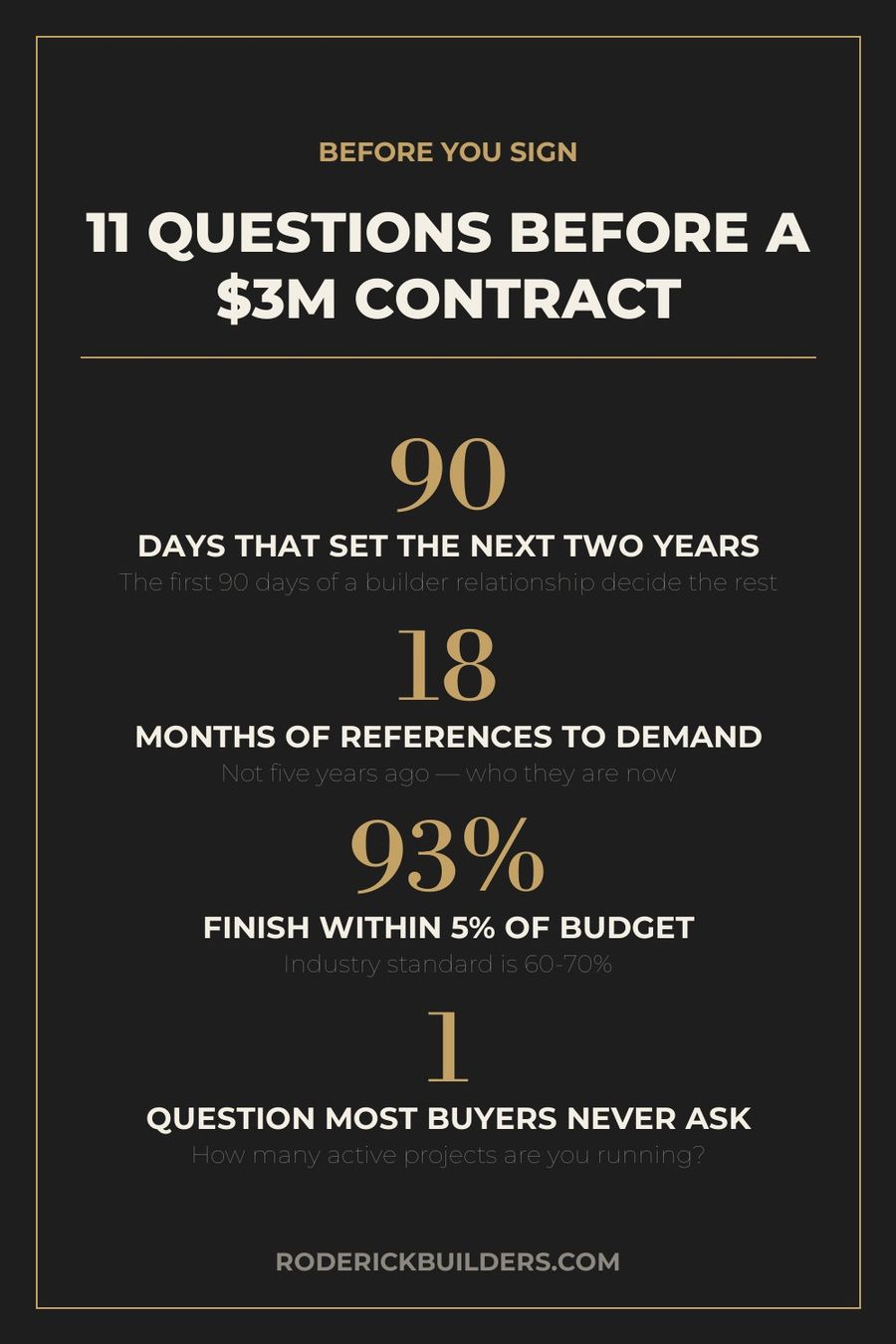
Here is what we know after completing multiple custom homes across Park City's luxury communities: the first 90 days of a builder relationship determine the next 18–24 months. The questions you ask before you sign a contract are the only leverage you will ever have.
11 Questions to Ask Before You Sign
1. How many active projects are you managing — and what's your project manager-to-project ratio?
This is the most revealing question most buyers never think to ask. A builder running 8–12 active projects with dedicated project managers is fundamentally different from one running 20+ with a thin oversight structure. In mountain building at elevation, active management is not a preference — it is the difference between a finished home and a call you do not want to receive. Ask specifically: does each project have a named project manager, and what is their current bandwidth?
2. Can I speak to three clients from projects completed in the last 18 months?
References from five years ago tell you who a builder was, not who they are now. The last 18 months have included material cost escalation, tariff shocks, and labor market tightening unlike anything most builders had experienced. A builder who performed well through that period has demonstrated something specific and verifiable.
3. How does your contract handle cost escalation?
Mountain construction budgets encounter predictable pressures: rock during excavation, engineered retaining requirements on steep lots, design changes from HOA review boards, and material price swings. Ask to see the cost escalation clause in the standard contract before you sign. Understand whether you are entering a fixed-price or cost-plus agreement — and what each means when circumstances change.
4. How long have your key subcontractors worked with you?
In Park City's skilled labor market, the best framing crews, electricians, and stone masons are committed years in advance. A builder's subcontractor roster tells the real story. If a builder cannot name their primary framer, electrician, and tile installer — or rotates subs project to project — their quality is inconsistent by design. Long-term sub relationships are not a nice-to-have. They are evidence of financial reliability and professional reputation.
5. Tell me about a project where something went wrong. How did you handle it?
Every honest builder has a story. A permit that required a redesign. A structural engineer who flagged an issue after framing was complete. A steel delivery that arrived damaged in January. What you are evaluating is not the problem — it is the character and competence of the response. The best builders have detailed, self-aware answers. Evasive or vague responses are significant red flags.
6. Do you have direct experience with this community's design review board?
Every luxury community in the Park City and Heber Valley area has its own DRB with specific aesthetic standards, materials approval processes, and revision cycles. Benloch Ranch, Promontory, Deer Valley's newer developments, and Wasatch County's upper-elevation communities all operate differently. A builder who navigates these relationships regularly has a material advantage in timeline efficiency. One who doesn't may cost you three to four months of unnecessary delays.
7. Can you provide references from your primary lenders and material suppliers?
This is uncomfortable to ask. Ask it anyway. In 2025 and 2026, several smaller builders across Utah's resort markets experienced cash flow issues as material costs spiked faster than billing cycles could accommodate. A well-capitalized builder with strong supplier relationships and a clean payment history protects you from becoming collateral damage in someone else's financial crisis. Review public records for any mechanics liens on recent projects.
8. What does client communication actually look like — week to week?
Weekly written updates. A dedicated project management platform. Named points of contact at every phase. These are minimums. If a builder's answer to this question is "you can call me anytime," that is not a communication system — it is a setup for frustration. Ask to see an example of a recent client update report, with identifying information removed.
9. What exactly does your warranty cover — and who administers it?
Structural warranties, materials warranties, and workmanship warranties are not interchangeable. In Utah, builders are required by law to provide certain warranty protections — but what matters in practice is how claims are handled. Ask for the actual warranty document. Read it. If you cannot get a written warranty document before signing a contract, that is your answer.
10. Have you built at this elevation and in these site conditions before?
Building above 6,500 feet in the Wasatch Range is a distinct discipline. Thermal bridging, snow load engineering, cold roof system design, frost-line footings, and moisture management at high altitude require site-specific experience. A builder who primarily works in the lower Heber Valley or Park City proper may not have meaningful experience with what a ridgeline lot at Benloch Ranch or a steep slope at Promontory actually demands.
11. What would you not build — and why?
The best builders have opinions. They know which lot configurations create problems. They know which design features look spectacular in renderings and perform poorly in the field. A builder who will build anything for anyone on any lot is a builder without conviction. The ones who push back thoughtfully — who say "here's what concerns us about this site" or "here's why that material choice is wrong for this climate" — are the ones worth hiring.
One More Decision: Design-Build vs. Traditional General Contractor
There is one structural question that shapes every decision above: are you working with a design-build firm or a traditional general contractor?
In the design-build model, a single entity manages both architectural design and construction under one contract. This eliminates the most common source of conflict and cost creep in luxury home projects: the gap between what an architect designs and what a builder can actually deliver on budget. When design and construction are unified under one leadership team, the client has a single point of accountability — and no one to blame but the builder if the budget and the drawings don't reconcile.
In Park City's market, where DRB approvals and permit timelines already extend the pre-construction phase by several months, eliminating that coordination gap is a meaningful competitive advantage — in time, in budget control, and in client experience.
A Note from the Builder
"The question we hear most from clients who’ve been burned elsewhere is: ‘Why didn’t anyone tell me to ask these things?’ Because nobody benefits from you asking hard questions except you. So we answer them proactively in the first conversation. Clients who ask hard questions build better homes." — Trapper Roderick, President, Roderick Builders
Start with the Right Conversation
Building in Park City is one of the most considered decisions a client makes. The market in 2026 rewards preparation. The eleven questions above are not a checklist — they are a framework for evaluating character, competence, and fit. Any builder worth hiring will welcome every one of them.
If you are thinking about building at Benloch Ranch, Promontory, Deer Valley, or anywhere in the Wasatch Back, we are glad to start that conversation — including answering these questions ourselves, on the record. Visit roderickbuilders.com/benloch-ranch or roderickbuilders.com/services to learn more, or reach out directly to begin.
Frequently Asked Questions
How long does it take to build a custom home in Park City?
The full timeline from lot purchase to move-in typically runs 20–30 months in Park City and surrounding communities. This includes 2–4 months for design development, 1–3 months for DRB review, 1–3 months for permit approval, and 14–20 months of active construction. Mountain building conditions — including restricted winter pour windows and spring ground-thaw periods — affect scheduling in ways that don't apply to lower-elevation construction. Buyers aligned with the 2034 Olympics timeline should plan accordingly.
What is the cost to build a custom home in Park City in 2026?
Custom home construction costs in Park City range from $625 to $1,500+ per square foot depending on location, elevation, materials, site conditions, and specification level. Deer Valley proximity and ridgeline lots typically land at the upper end of that range. These figures do not include land, soft costs (architecture, engineering, permits), or landscaping, which can add 20–35% to total project investment. Tariff impacts in 2026 — particularly the 50% duty on imported cabinet and vanity components effective January 2026 — have added meaningful cost to high-specification finishes budgets.
What is the difference between a design-build firm and a traditional general contractor?
A traditional general contractor constructs from plans delivered by a separate architect. A design-build firm manages both design and construction under a unified contract. The design-build model reduces cost uncertainty, eliminates coordination gaps between design intent and construction reality, and creates a single point of accountability. In a market with complex DRB requirements and site-specific design challenges, the design-build approach typically results in faster pre-construction timelines and fewer costly surprises.
Which communities in the Park City area allow custom home construction?
Major communities currently accepting custom home builds include Benloch Ranch (Wasatch County, near Kamas), Promontory (Summit County), and select parcels in the greater Deer Valley area. Each has distinct design review requirements, elevation profiles, and covenant structures. Benloch Ranch is a 2,550-acre master-planned community with mountain views and Wasatch County permitting advantages. Promontory lots tend to carry stronger HOA requirements and higher baseline pricing. Lot selection is itself a discipline — orientation, slope, soil conditions, solar access, and site access all materially affect construction cost and complexity.
How do I verify that a builder is financially stable before signing?
Request supplier and lender references directly and follow up on them. Ask how the builder handles retainage with subcontractors and whether they maintain a funded contingency reserve on active projects. Review Utah public records and the Division of Professional Licensing for any complaints or disciplinary actions. Search for mechanics liens filed against recent projects — these are public record and indicate unpaid subcontractors. A financially healthy builder will be comfortable discussing their financial practices openly.
What happens if I need to make changes during construction?
Change orders are a normal part of custom home construction. What varies dramatically between builders is how they are priced and processed. The best builders have a formal change order process: written scope, priced before work commences, signed by both parties before execution. Verbal agreements or informal 'we'll work it out' approaches are the source of the majority of client-builder disputes. Clarify the change order process before signing your contract — it will tell you a great deal about how the builder operates.
What questions should I ask a custom home builder in Park City?
The most important questions include: How many active projects are you managing and what is your PM-to-project ratio? Can I speak to recent client references? How does your contract handle cost escalation? How long have your key subcontractors worked with you? Tell me about a project where something went wrong. Do you have DRB experience in this specific community? Can you provide financial references? What does weekly communication look like? What does your warranty actually cover? Have you built at this elevation before? And: what would you refuse to build, and why? Any builder worth hiring will welcome all of these.