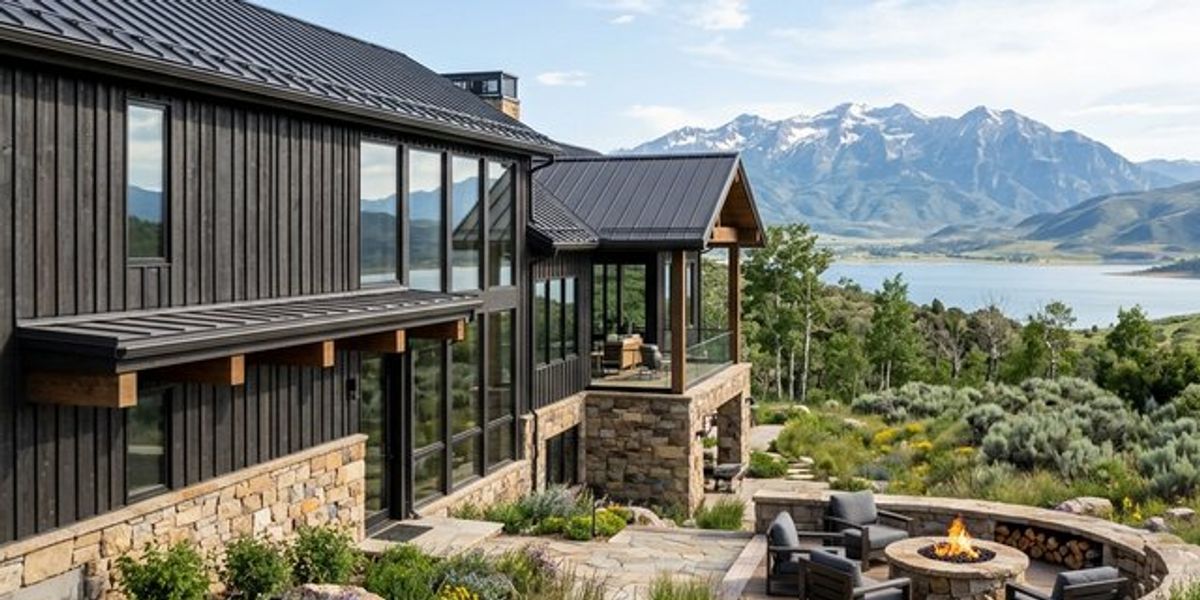
The lab result came back at 7.8 pCi/L. The home was three years old. Custom build. Promontory address. Cedar siding, copper roof, finished walkout where the family did their morning workouts.
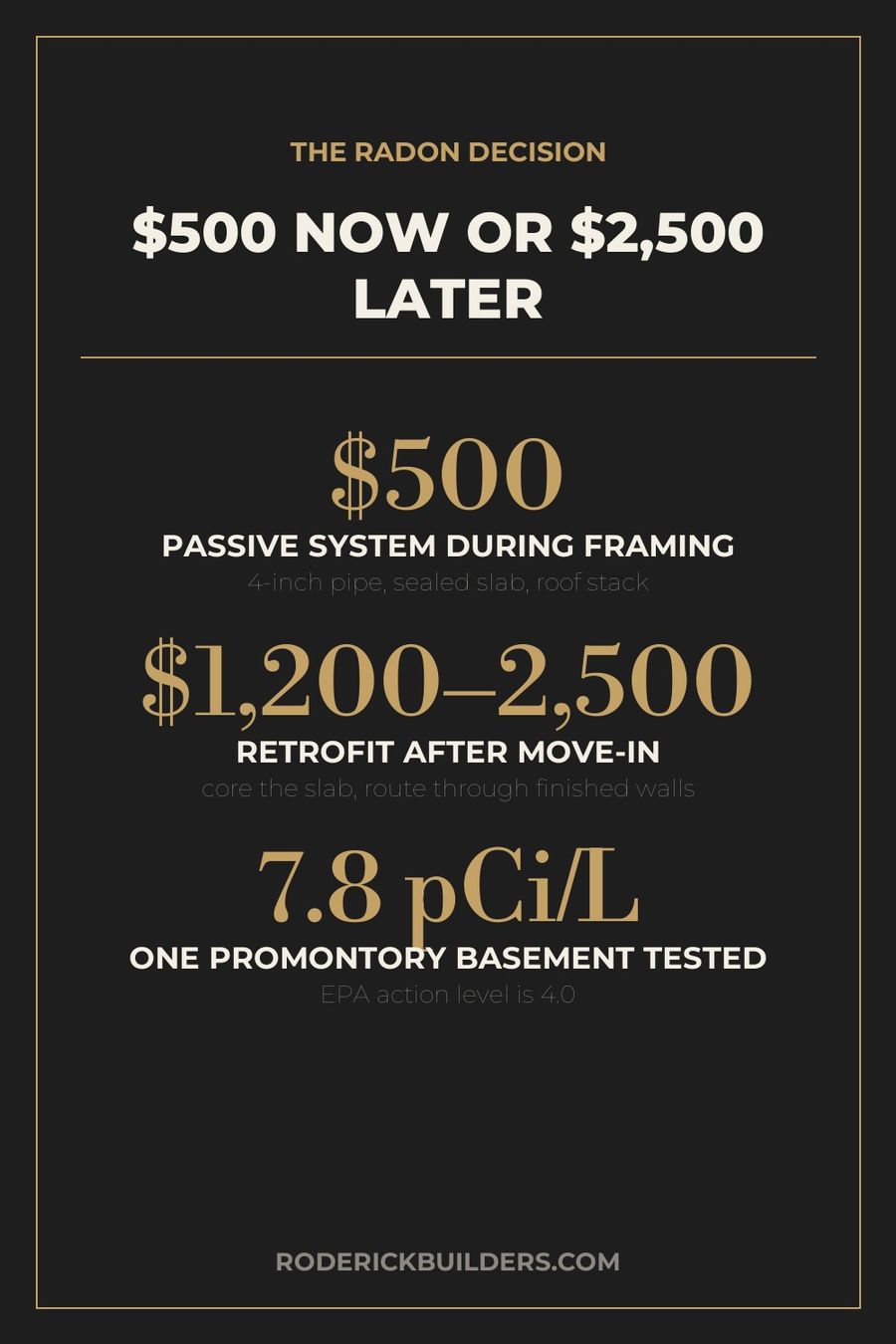
The owner read the number twice. The EPA action level is 4 pCi/L. The basement was running close to double that.
The mitigation contractor quoted $2,400 to retrofit. Then he said the line every builder in Park City should be repeating to clients before framing starts:
If your builder had spent five hundred dollars during construction, you would not be writing this check.
What radon actually is — and where it lives in Park City
Radon is a colorless, odorless, radioactive gas. It is produced when uranium and radium in soil break down. It moves up through the ground, finds its way into a home through foundation cracks, sump pits, and slab penetrations, and accumulates indoors — especially in basements and lower levels.
The U.S. Surgeon General lists radon as the second leading cause of lung cancer in the United States, behind smoking. There is no taste, no smell, no immediate symptoms. You learn you had a problem when your physician orders a scan.
Park City sits in an EPA-designated Radon Zone 2, with predicted indoor screening averages between 2 and 4 pCi/L. Both the 84060 and 84098 zip codes show recent testing averages near 2.0 pCi/L.
That number sounds reassuring until you read what an average conceals. Individual lots across Summit County have tested well above the EPA’s 4 pCi/L action level. In April 2024, Park City’s local outlet TownLift reported two Summit County residents diagnosed with non-smoking lung cancer, with radon flagged as the suspected cause.
The Utah Geological Survey has documented problem-soils zones throughout the Wasatch Back where radium-rich rock and fractured bedrock create the exact conditions radon thrives in.
The core insight: $500 now or $2,500 later
Building a passive radon-resistant system during construction costs approximately $500 in materials and labor on a typical Park City custom home.
The system is straightforward:
- A 4-inch perforated pipe runs through a 4-inch layer of clean gravel beneath the basement slab.
- The vapor barrier is sealed at every penetration.
- A vertical pipe runs from the gravel layer up through the conditioned envelope to a roof termination.
- The sump pit lid is sealed and gasketed.
- Electrical is stubbed for an inline fan in case the home tests over the action level after the first heating season.
That is the build-it-in cost. Five hundred dollars on a home that may exceed five million in total construction.
The retrofit number is a different conversation. Certified Park City mitigation contractors typically price retrofit active systems between $1,200 and $2,500.
The work is invasive:
- Concrete coring through the basement slab.
- New PVC traced up through finished walls and closets.
- An exterior fan housing bolted to a previously clean elevation.
- Electrical added after drywall is in.
Then there is the operating math. A retrofit active fan running through Park City’s long heating season can add up to $200 a year in conditioned-air loss and electrical draw, by federal Department of Health figures. A passive system designed in from the start operates at closer to $14 per year if a fan is ever added at all.
Five hundred dollars during framing — or two-thousand-plus after move-in, with worse aesthetics and a higher operating cost forever. That is the radon decision Park City custom homes are quietly skipping.
Why Park City’s geology matters more than the EPA zone label suggests
The EPA radon zone system is a county-level average. Summit County’s Zone 2 assignment puts it in the middle bracket on a national map. That is a useful starting point and a misleading endpoint.
Three things change the math at the lot level in Park City.
1. The underlying geology
The Park City Formation and adjacent rock units carry measurable uranium content. As that uranium decays, radon-222 is released.
Highly fractured bedrock — the same fractured rock that drains snowmelt so efficiently across the Wasatch Back — gives the gas a fast path upward.
The Utah Geological Survey has mapped problem-soils zones across the region. Several sit directly under communities where custom homes are actively under construction today.
2. The program
Mountain modern homes in Park City lean hard on basements and walkout lower levels. That is where families put:
- the home theater
- the bunk room
- the wine room
- the gym
- the second kitchen
Those are the rooms children sleep in over guest weekends, where someone exercises sixty minutes a day, where the dog spends winter mornings on the treadmill.
Radon concentrations are highest where ground contact is greatest. The luxury-home floor plan puts the most-used rooms exactly where the gas collects.
3. The building envelope
A Park City custom home in 2026 is tighter than anything the market was building twenty years ago:
- Spray foam at the rim joist
- Continuous exterior insulation
- Triple-pane window walls
- Blower-door results passing at 1.0 ACH50 or better
That envelope is what gives the home its energy performance. It is also what holds onto whatever air enters the basement.
A leaky 1985 ranch in Heber breathes its radon out. A 2026 mountain modern at Promontory or Benloch holds onto it.
The combination — radium-rich rock, basement-heavy floor plans, near-airtight envelopes — is exactly the wrong recipe to skip a $500 mitigation system on.
[Project not found]
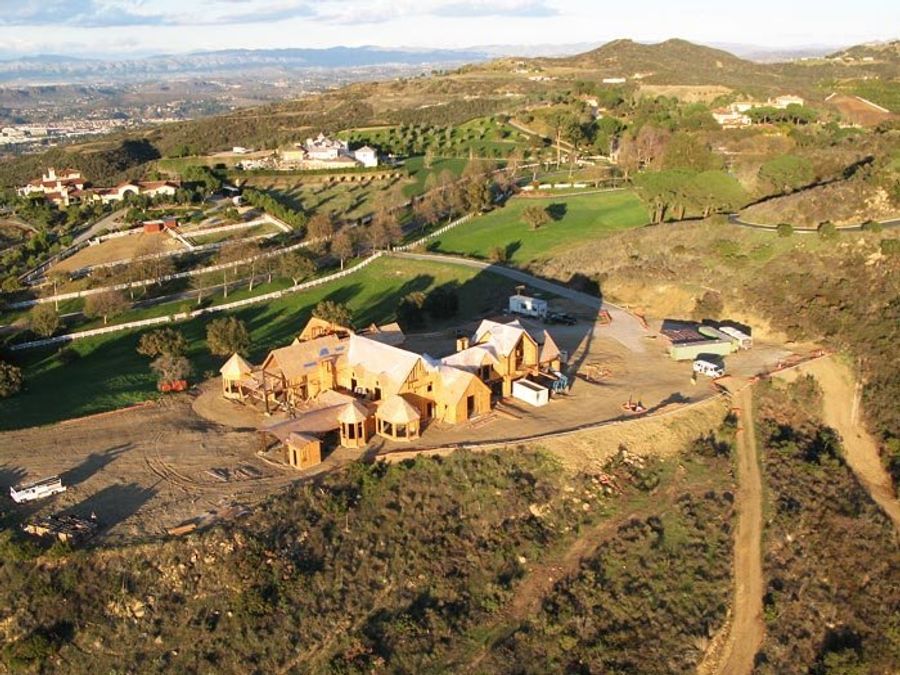
The comparison — what other states already do by code
Several states require radon-resistant new construction either statewide or in high-risk zones. Iowa, Illinois, Minnesota, Washington, and Oregon all have versions of this requirement.
Wisconsin’s Department of Health publishes specific radon-resistant new construction guidance and treats it as a baseline for responsible builders. The EPA’s Indoor airPLUS new home label, used widely in green-building markets, requires radon-resistant features as a minimum.
Utah does not require it. Summit County does not require it. There is no checkbox on a Park City permit application that flags whether your custom home has a passive radon stack. The market relies entirely on what your builder volunteers to specify.
That is the gap. Production builders skip the system because five hundred dollars is a margin call against a tract-home spec sheet. Most luxury custom builders in Park City skip it because the client never asked, the architect never drew it, and the inspector never failed a wall for not having it.
Roderick Builders specifies radon-resistant features on custom homes where lot conditions warrant. We treat it the same way we treat a cold roof, a vapor barrier, or an air-sealing detail. It is not an upgrade. It is what a serious build at altitude includes.
Frequently asked questions
Is radon really a problem in Park City?
On the right lots, yes. Summit County is EPA Radon Zone 2, with average screening levels around 2 pCi/L, but individual homes here have tested well above the EPA 4 pCi/L action level.
The risk is lot-specific. The Park City Formation and broken bedrock common to the Wasatch Back create the geology radon depends on. The only way to know your specific lot’s risk is to test post-build — and to design a system in before you ever need to know.
What is the EPA action level for radon?
The EPA action level is 4 picocuries per liter of air (4 pCi/L). The EPA recommends mitigation at or above 4 pCi/L. Action is encouraged between 2 and 4 pCi/L. Below 2 is considered relatively low risk.
How much does radon mitigation cost on a Park City custom home?
- Roughly $500 to install a passive radon-resistant system during new construction.
- Roughly $1,200 to $2,500 to retrofit an active system into an existing home, depending on size and access.
- Operating cost of a retrofit fan-driven system runs up to $200 per year in northern climates.
- A passive system designed in from the start operates at closer to $14 per year if a fan is ever added at all.
How does a passive radon system actually work?
- A 4-inch perforated pipe is laid in a 4-inch gravel layer below the basement slab.
- A vertical pipe runs from that gravel layer, through the conditioned envelope, to a roof exhaust point.
- The sump pit is sealed.
- The vapor barrier separates living space from soil contact.
The natural stack effect — warm air rising — vents soil gas above the roofline before it can collect indoors. If post-occupancy testing shows the home still exceeds 4 pCi/L, an inline fan is added at the rough-in and the system becomes active.
Should I test my Park City home for radon?
Yes, in the first heating season after move-in. Short-term test kits run $20 to $30. Long-term kits provide a better view of average exposure. The Summit County Health Department publishes testing and mitigation guidance.
Does radon-resistant construction qualify for certifications?
Yes. Radon-resistant features are required under the EPA’s Indoor airPLUS new home label, count toward LEED for Homes credits in several categories, and are part of NGBS Indoor Environmental Quality criteria.
Why don’t more Park City custom homes have radon systems already?
There is no state or county code that requires them. The cost during construction is small enough that it never surfaces in budget conversations. Most architects, project managers, and inspectors in the area do not raise it.
We think that is the wrong default for a market building at altitude on radium-rich geology.
Can I add a radon system later if I already moved in?
Yes — though it is meaningfully more expensive, more invasive, and more visible than building one in.
Plan on $1,200 to $2,500, plus the annual operating cost. The work involves coring the slab, routing pipe through finished space, and installing an exterior fan housing.
Planning a Park City custom home? Make radon part of the conversation.
If you are designing or building in Summit County, a passive radon system is a small line item that protects how your home lives for decades. We can help you evaluate your lot, coordinate with your designer, and build radon-resistant details into the foundation and framing package from day one.
Talk with Roderick Builders about radon-ready constructionThe close
We have written about the small decisions that decide how a Park City custom home lives over the next thirty years. Cold roof design. The geotechnical report. Heated drives. The window wall. Add radon to the list.
Five hundred dollars at framing, or two-thousand-plus later — with worse aesthetics and a known lung-cancer risk sitting between the two. The honest answer is to build it in. Let’s start a conversation.
Frequently Asked Questions
Is radon really a problem in Park City new construction?
Yes, on the right lots it is a real risk. Summit County is EPA Radon Zone 2 with average screening levels around 2 pCi/L, but individual homes have tested well above the EPA 4 pCi/L action level. Park City’s radium-bearing geology, fractured bedrock, and basement-heavy luxury floor plans all increase the chance that a specific home will see elevated radon unless mitigation is designed in.
What is the EPA action level for radon in homes?
The EPA action level is 4 picocuries per liter of air (4 pCi/L). The EPA recommends mitigation at or above 4 pCi/L and encourages action between 2 and 4 pCi/L. Levels below 2 pCi/L are considered relatively low risk, but the goal is always to reduce exposure as much as reasonably achievable.
How much does it cost to add radon mitigation during Park City new construction?
On a typical Park City custom home, a passive radon-resistant system added during construction costs about $500 in materials and labor. That includes sub-slab piping in the gravel layer, a sealed vapor barrier, a vertical vent stack to the roof, a sealed sump lid, and an electrical stub for a future fan if needed after post-occupancy testing.
What does a radon retrofit cost after the home is finished?
Retrofitting an active radon mitigation system into a finished home in Park City typically runs between $1,200 and $2,500, depending on the home’s size and how easily a vent path can be routed. The work usually involves coring through the slab, running new PVC through finished walls or closets, adding an exterior fan housing, and installing new electrical after drywall.
How does a passive radon system work in a custom home?
A passive system collects soil gas under the slab and uses the home’s natural stack effect to vent it above the roofline. A 4-inch perforated pipe is laid in a 4-inch gravel layer beneath the basement slab and connected to a vertical vent that runs through the conditioned space to the roof. The vapor barrier and sump lid are sealed so soil gas prefers the vent path. If post-build testing shows levels above 4 pCi/L, an inline fan is added to convert the system to active.
When should I test my Park City home for radon?
The best time to test is during the first heating season after move-in, when windows are closed and the home is operating as it will in daily life. Short-term test kits cost around $20–$30 and give a quick snapshot. Long-term kits provide a better picture of average exposure. Summit County Health Department offers guidance on testing and interpreting results.
Does radon-resistant construction help with green or healthy home certifications?
Yes. Radon-resistant features are required under the EPA’s Indoor airPLUS label, contribute to LEED for Homes credits in indoor environmental quality and durability categories, and are part of National Green Building Standard (NGBS) Indoor Environmental Quality criteria. Including a passive radon system supports both health and certification goals.
Why isn’t radon-resistant construction required by code in Park City?
Utah and Summit County currently do not mandate radon-resistant new construction, even in higher-risk areas. That means there is no permit checkbox or inspection item forcing the issue. Many production and even luxury builders skip it because the client doesn’t ask, the architect doesn’t draw it, and the inspector doesn’t require it, despite the relatively low cost and clear health benefit.
Can I add a radon system later if my Park City home is already built?
Yes. A certified mitigation contractor can retrofit an active radon system into an existing home by coring the slab, installing sub-slab piping, routing a vent stack, and adding a fan. However, it is more expensive, more invasive, and more visually noticeable than installing a passive system during construction, and it comes with higher long-term operating costs.
Is a passive radon system enough for a Park City custom home, or do I need an active fan from day one?
In most cases, a well-detailed passive system installed during construction is the right starting point. It provides a clear vent path and sub-slab collection field at minimal cost. After the first heating season, you test the home. If levels are at or above 4 pCi/L, an inline fan is added to the rough-in to convert the system to active. Designing the passive system up front keeps that upgrade simple and inexpensive.